Laravel vs Node.js with React: Choosing the Right Tech Stack for Your Web Application
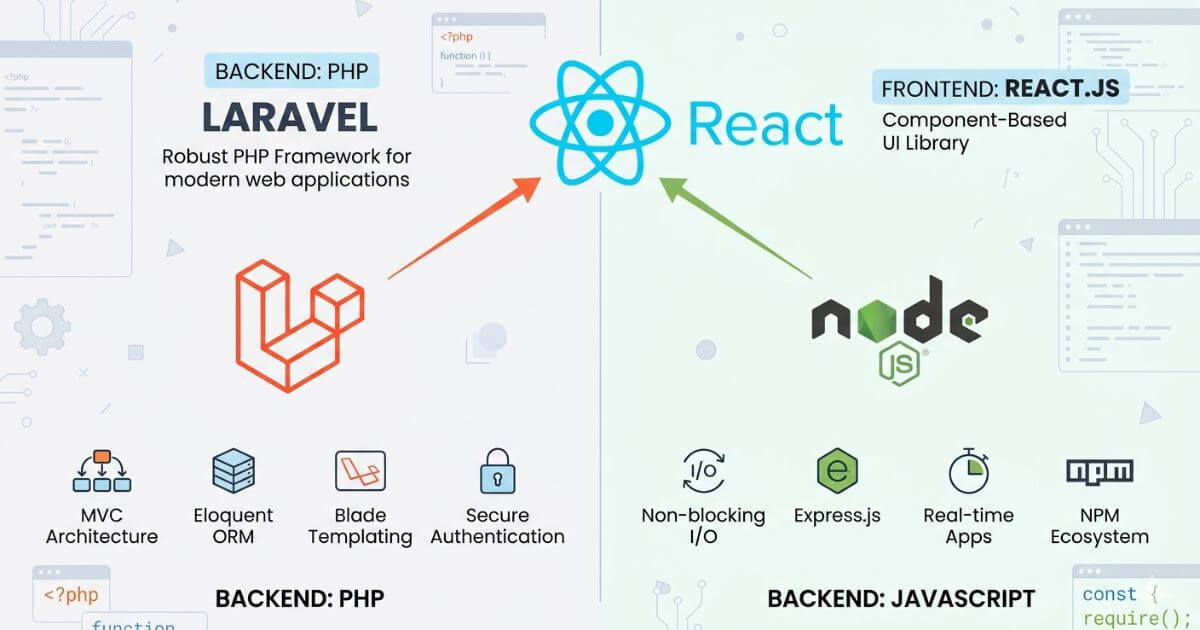
Choosing the right tech stack is one of the most important decisions when building a scalable web application. Among the most popular combinations today are Laravel + React JS and Node.js + React JS.
Both stacks are powerful, modern, and widely adopted. However, the right choice depends on your business goals, performance needs, and scalability expectations.
Not every powerful technology is the right fit—choosing the right stack is about aligning with your application’s real needs.
🔷 Overview of the Tech Stacks
Laravel + React JS
Laravel is a PHP-based framework known for its elegant syntax and structured MVC architecture. It simplifies backend development with built-in tools and strong conventions.
- Structured MVC architecture
- Built-in authentication and security
- Faster development for business applications
Node.js + React JS
Node.js is a JavaScript runtime designed for scalability and real-time applications. It uses an event-driven, non-blocking architecture ideal for handling concurrent users.
- Event-driven architecture
- Excellent for real-time systems
- Highly scalable
⚙️ Laravel vs Node.js: Detailed Comparison
| Feature | Laravel + React | Node.js + React |
|---|---|---|
| Architecture | MVC (Structured & Opinionated) | Event-driven (Flexible) |
| Performance | Good for standard workloads | Excellent for high concurrency |
| Development Speed | Faster with built-in features | Requires setup & planning |
| Scalability | Moderate (can scale well) | Highly scalable |
| Real-time Capability | Limited (needs extra tools) | Native strength |
| Security | Strong built-in security | Depends on implementation |
| Cost | Lower development cost | Slightly higher |
🚀 Development Speed & Productivity
Laravel significantly reduces development time with features like authentication, ORM (Eloquent), queues, and validation systems.
Node.js provides flexibility but requires developers to make architectural decisions early, which can slow down initial development.
- Laravel: Ideal for fast MVPs and business applications
- Node.js: Best for custom, scalable architectures
💰 Cost Consideration
Laravel projects are generally more budget-friendly due to faster development cycles and easier maintenance.
Node.js projects may have higher upfront costs but are more suitable for long-term scalability and high-performance systems.
- Budget-focused projects → Laravel
- Scalable enterprise systems → Node.js
🔐 Security Comparison
Laravel comes with built-in protection mechanisms such as CSRF protection, input validation, and authentication systems.
Node.js security depends on the libraries and practices used by developers, requiring careful implementation.
🔗 Integrations & Ecosystem
Both Laravel and Node.js support modern integrations such as payment gateways, APIs, and notification systems.
- Stripe integration works seamlessly in both
- Laravel offers built-in notification and queue systems
- Node.js excels in real-time notifications
📊 Best Use Cases
- CRM & Business Applications: Laravel
- Real-time systems: Node.js
- Billing & workflows: Laravel
- Live notifications: Node.js
📈 Scalability & Future Growth
Node.js is naturally suited for microservices and high-traffic systems due to its non-blocking architecture.
Laravel can also scale effectively with proper infrastructure, but may require additional tools for real-time features.
🧠 Final Thoughts
There is no universal winner between Laravel and Node.js. The best choice depends on your project requirements.
- Choose Laravel: For structured, cost-effective, and fast development
- Choose Node.js: For real-time, scalable, and high-performance systems
In many cases, a hybrid approach—using Laravel for core business logic and Node.js for real-time services—can provide the best of both worlds.
✅ Conclusion
Both Laravel and Node.js with React are powerful tech stacks. The key is to align your technology choice with your business goals, scalability needs, and long-term vision.